Surprising fact: over 90% of indoor spaces carry airborne spores at any time, so complete eradication is not realistic.
You likely want a quick fix when you spot growth on a wall. Many restoration firms use words like mold abatement and mitigation interchangeably, which only adds confusion.
Here’s the key idea: a simple cleaning often removes visible patches, while true remediation targets moisture, structure, and long-term health risks.
EcoFMR and similar companies warn that a surface service can leave underlying causes active. If someone in your home has sensitivities, choosing the right approach matters.
This short guide helps you tell if professionals are offering a cosmetic fix or a full process that aims to protect your living space and health.
Key Takeaways
- Airborne spores are normal; total eradication is impossible.
- Surface cleaning often hides, but does not fix, root causes.
- True remediation addresses moisture, structure, and safety.
- Ask a company about long-term solutions, not just quick cleanup.
- Choose a service that prioritizes health for sensitive household members.
Understanding the Basics of Household Mold
Tiny fungal threads can start quietly in damp corners of your house. They form multicellular filaments called hyphae and thrive in warm, dark spots with steady moisture.
What it is
Mold is a natural fungus that reproduces via microscopic spores. When spores land on a wet surface, they feed, spread, and can create visible growth in basements, attics, bathrooms, and inside wall cavities.
Health risks of exposure
Short-term exposure may cause nasal congestion, throat irritation, coughing, wheezing, itchy eyes, or skin rash. Long-term exposure can worsen asthma or lead to respiratory infections for sensitive people.
- Common spots: under sinks, near leaky pipes, and any place with persistent water.
- Because spores travel through air, containment matters to stop spread.
- Quick removal of visible patches helps, but you must fix moisture or water sources to prevent recurrence.
- The remediation process aims to manage root causes and protect indoor air quality.
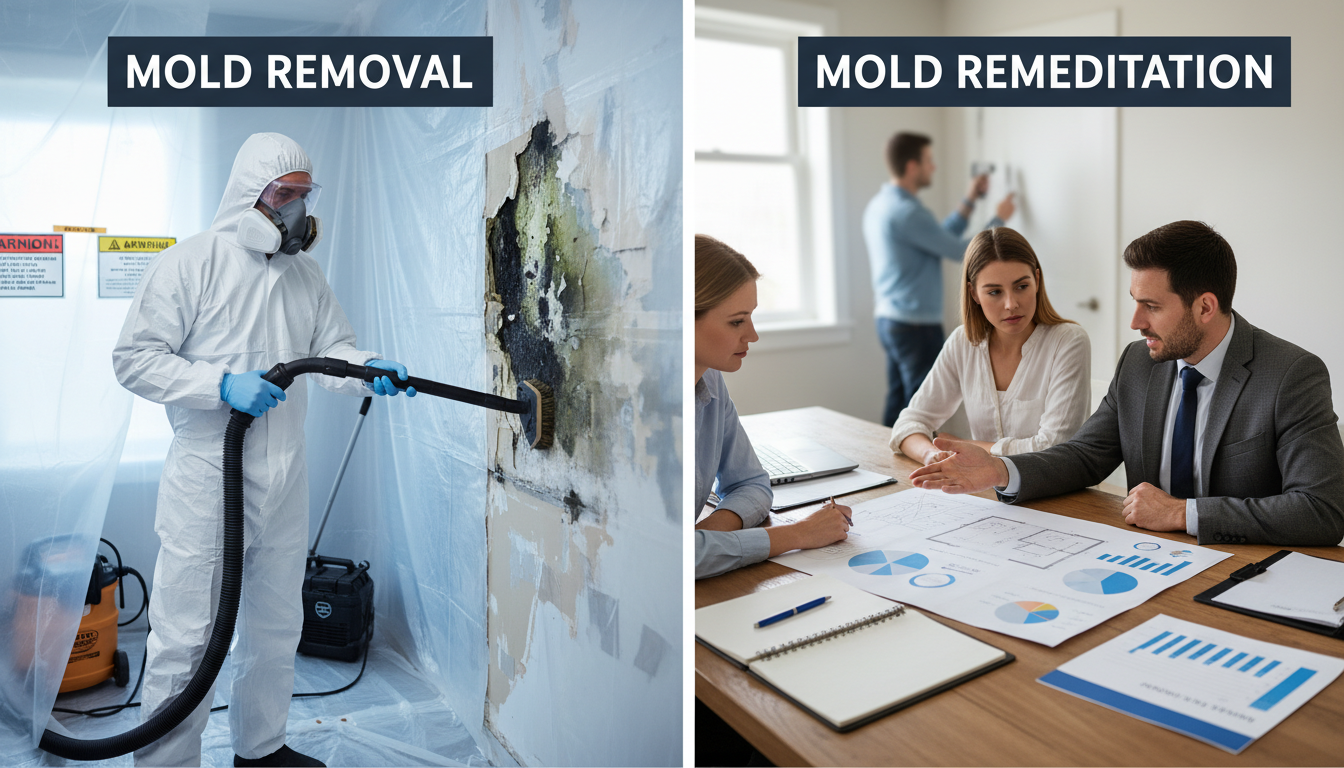
Mold Removal vs Mold Remediation What Is the Difference
Not all visible patches mean the same level of risk or the same fix. A quick cleaning may clear a spot, but it rarely addresses why growth happened.
Removal focuses on the visible effect. It often uses targeted cleaning or cutting out material to make the area look normal again.
Remediation is a full process. A professional company tests, contains, and sanitizes. Technicians may perform controlled demolition and use air filtration to keep spores from spreading.
Pick remediation when you want a lasting solution for your home and health. It restores a safe fungal ecology in affected areas rather than just hiding the problem.
| Service | Focus | When to choose |
|---|---|---|
| Removal (cleaning) | Visible patches and quick fixes | Small, isolated spots on non-porous surfaces |
| Remediation (full service) | Root cause, testing, containment, sanitizing | Recurring growth, large areas, or health concerns |
| Professional inspection | Assessment and testing | When you need levels measured and a plan |
- The main contrast: effect-focused cleaning vs. cause-focused solutions.
- True remediation uses tools and testing to control spores and restore safe levels.
- Choose a licensed company if you want to get rid of problems for good and protect your property and health.
The Scope of Professional Mold Remediation
A professional service follows a clear plan so you can trust the work and the outcome.
Inspection and assessment
Experts start with a detailed inspection to find the source of growth and check affected areas.
They test surfaces and air to measure levels and identify hidden wet spots.
Containment and air filtration
Technicians isolate the workspace with plastic sheeting and set up negative air pressure to stop spread.
They use HEPA vacuuming and air scrubbing to capture spores and improve indoor air quickly.
Sanitization and restoration
Sanitization includes antimicrobial application and fogging to remove odors and reduce active colonization.
Porous materials that are too damaged get removed, while sound structures are cleaned and sealed with mold-proof coating.
| Step | Main actions | Goal |
|---|---|---|
| Assessment | Visual, moisture mapping, air testing | Pinpoint source and plan the work |
| Containment | Plastic barriers, negative air machines | Prevent cross-contamination |
| Filtration & cleaning | HEPA vacuuming, air scrubbing, antimicrobial | Lower airborne spores and sanitize areas |
| Restore | Remove damaged materials, apply coatings | Return your home to a safe, long-term state |
In short: a full remediation process protects your property and health by treating cause and effect, not just surface cleaning. Make sure you hire trained technicians who follow these steps.
When to Choose Simple Removal
If the affected zone is tiny and on a hard surface, a basic cleanup often works. You can treat spots under about 10 square feet on tile, metal, or sealed countertops with household cleaners and elbow grease.
Before you clean: stop the moisture source. Fix a leaky faucet or dry a wet cabinet. Without that step, stains will likely come back.
Work carefully to avoid spreading spores. Wear gloves and a mask, isolate the area, and ventilate while you clean. Use a dehumidifier afterward if humidity is high.
- Small areas on non-porous surfaces are often safe for DIY cleaning.
- If the stain returns, call a company to inspect and discuss a full remediation process.
- When in doubt, get professional advice to protect your home and property.
| Scenario | Recommended action | Why |
|---|---|---|
| Under 10 sq ft on tile/metal | DIY cleaning | Easy to clean, low risk if moisture fixed |
| Recurring stains after cleaning | Call a professional | May need testing and full remediation process |
| High humidity in rooms | Use dehumidifier + monitor | Prevents regrowth and protects walls |
For guidance on the full mold remediation process, read this short guide on the mold remediation process.
Identifying Signs of a Larger Infestation
A lingering, earthy smell in your house is often the earliest clue of a serious problem. That persistent musty odor usually points to hidden growth behind walls, under flooring, or inside HVAC systems.
Watch for physical symptoms: sudden coughing, throat irritation, itchy eyes, or wheezing that ease when you leave your home suggest spores are circulating in your air.
Inspect high-risk areas regularly: attic, basement, bathroom, and around plumbing. Look for damp spots, water stains, or visible patches on walls and ceilings.
- If surface coverage exceeds 10 square feet, stop DIY cleaning and call professionals for a full remediation process.
- Hidden colonies often stem from unseen water leaks, so check under floors and behind drywall when possible.
- Specialized detection tools can find contamination in places you cannot see and protect your property long term.
Why You Should Avoid DIY Cleanup
Trying a DIY cleanup can accidentally spread spores into rooms you thought were safe.
When you tackle a large patch yourself, containment is often missing. That lets spores move through air and ducts and can turn a local growth into a whole-house problem.
Professionals in Sacramento, like JM Environmental, follow strict industry terms to prevent this. They set up barriers and use negative air machines so clean areas stay protected.
Remediation involves more than surface cleaning. Experts test air and surfaces, find moisture and water sources, and use industrial dehumidifiers to dry your property.
| Risk | DIY action | Professional service |
|---|---|---|
| Spore spread | High — poor containment | Low — controlled negative air |
| Hidden sources | Often missed | Identified via testing |
| Long-term recurrence | Likely if moisture stays | Lower with full remediation |
| Health & property risk | Elevated without equipment | Managed by trained experts |
Make sure you weigh short-term savings against potential costs to health and property. For large infestations, hiring a licensed company keeps air quality safe and helps stop stains from coming back.
Conclusion
Knowing when to call a pro helps you avoid costly repeats and health risks. If you spot small visible spots, a simple removal may work, but larger or recurring issues need a full remediation plan.
Choose certified technicians who offer inspection, testing, and a clear process to find and fix moisture sources. Proper work lowers airborne levels and protects your indoor air and family’s health.
Make sure you prioritize professional assessment when coverage is wide or symptoms persist. The right service treats cause, not just effect, and helps keep your home safe long term.