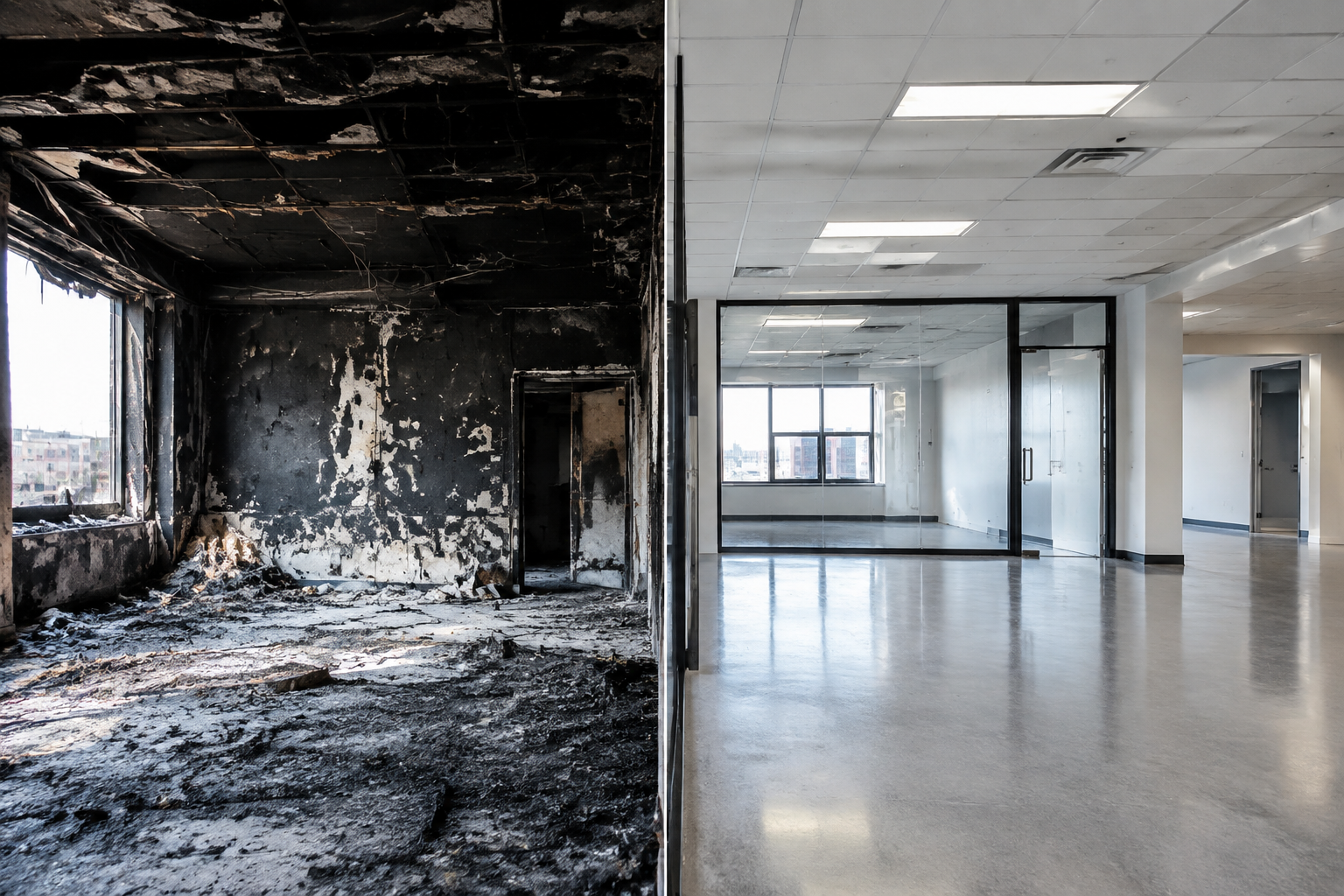
Sixty minutes. That’s the window that separates a smoke-stained building from one that’s lost to soot, water, and mold. Fire damage doesn’t sit still — it spreads through HVAC ducts, soaks into drywall, and turns a manageable cleanup into a gut-rehab job overnight. For a Brooklyn property manager staring at a smoldering unit in Bed-Stuy or a warehouse fire near the Gowanus, the clock isn’t a metaphor. It’s the difference between reopening in three weeks or three months.
Fire damage restoration services exist for exactly this reason: to show up fast, stabilize the property, and stop secondary damage before it multiplies the loss. But not every company treats speed the same way. Some quote a 24-hour arrival window and call it responsive. That’s not fast — not in a borough where narrow streets, alternate-side parking, and five- and six-story walk-ups make every minute of delay compound into water damage, structural risk, and tenant complaints piling up in the lobby.
Brooklyn’s older housing stock — brownstones with shared walls, prewar multi-family buildings, mixed-use blocks in Sunset Park and Williamsburg — adds its own wrinkles. Smoke travels differently through a building built in 1920 than one built last decade. Firefighting water pools in places you wouldn’t expect. And insurance adjusters need documentation fast if a claim’s going to move without a fight.
So what does a genuinely fast, professional response actually look like, and how do you tell the difference between a restoration company that talks a good game and one that shows up ready to work? That’s exactly what property managers and building owners across Brooklyn need to know before the next fire — not after.
What Counts As a Fast Response Time From a Fire Restoration Company?
A pipe of smoke is still rolling off a Sunset Park warehouse roof when the fire department clears the scene at 6 a.m. The owner is standing on the sidewalk, insurance card in hand, wondering who shows up next — and how fast. That’s the real test of fire damage restoration services. Not what they promise on a website. What they actually do at 6 a.m. on a Tuesday.
Why 60 Minutes Is the Benchmark, Not 24 Hours
Some companies still advertise same-day service like it’s impressive. It isn’t. Soot bonds to metal and grout within hours, and smoke odor drives deep into drywall the longer it sits. A 60-minute arrival window is the standard that actually limits damage — not a courtesy, a necessity. That gap between hour one and hour twenty-four often decides whether a building needs new subfloors or just a deep clean.
How Brooklyn’s Density Affects Response Logistics
Brooklyn isn’t Reno or a quiet stretch of Utah highway. Narrow streets in Park Slope, alternate-side parking, and multi-unit buildings in Bed-Stuy all slow truck access. A crew has to plan routes before dispatch, not after. That’s also why fast teams coordinate property damage restoration for insurance claims from the first walkthrough — documentation starts the same hour equipment does.
What Happens in the First 24 Hours After a Fire in a Brooklyn Building?
The first day decides whether your loss stays contained or spreads into a bigger, uglier repair bill. In Park Slope brownstones or a Sunset Park warehouse, crews should be on-site within an hour of that first call — not tomorrow morning. Fast mobilization is what separates real fire damage restoration services from outfits that show up when it’s convenient for them.
Board-Up and Tarping to Stop Secondary Damage
Broken windows, a hole in the roof, exposed walls — all of it invites weather, theft, and pests into an already-damaged building. Crews board up openings and tarp the roof immediately, before soot even gets touched. Skip this step and rain turns a fire loss into a mold problem within 48 hours. That’s not a maintenance issue anymore; it’s a second disaster stacked on the first.
Initial Damage Assessment and Insurance Documentation
Photos, moisture readings, room-by-room notes — this documentation is what supports your fire damage restoration insurance claim later, so it needs to happen before cleanup starts, not after. Building owners should ask one question before signing anyone on: are you an IICRC certified commercial restoration contractor? If the answer’s no, keep calling.
What Does a Fire Restoration Company Actually Do, Step by Step?
What actually happens once a crew rolls up to a burned-out storefront on Flatbush Avenue? It’s not just shop-vacs and air fresheners. A real fire damage restoration services team follows a set process — assessment, drying, cleaning, rebuild — and skipping steps is how buildings end up with hidden smoke odor two months later.
Soot and Odor Inspection
First, techs walk the property with thermal cameras and soot sponges, checking HVAC ducts, drop ceilings, and wall cavities. Brooklyn brownstones with plaster walls hold smoke differently than a modern warehouse space in Sunset Park — porous materials need deeper testing before anyone quotes a repair plan.
Water Removal From Firefighting Efforts
Here’s the part most owners forget: the fire department’s hose work often causes more standing water damage than the flames themselves. Extraction pumps and dehumidifiers go in within hours, because untreated water sitting in a Brooklyn basement in humid August air breeds mold fast. This step also matters for a clinic fire damage restoration job, where moisture control isn’t optional — it’s a compliance issue tied to patient safety.
Structural Drying and Rebuild Planning
Once moisture readings drop to normal, crews map out load-bearing damage — and draft a rebuild scope. This is where cost estimates get finalized — and where working directly with the building’s insurance adjuster saves owners weeks of back-and-forth.
How Much Does Fire Restoration Cost Per Square Foot in NYC?
Here’s a number that surprises most building owners: fire restoration cost typically runs $4 to $10 per square foot for smoke and soot cleanup alone, but that figure jumps past $30 once structural rebuild, water extraction from firefighting efforts, and code-required upgrades get added in. A 2,000-square-foot Brooklyn brownstone floor with moderate smoke damage can land anywhere between $15,000 and $60,000 depending on how deep the soot traveled into the walls.
Factors That Push Costs Higher in Multi-Family or Commercial Buildings
Multi-family and commercial properties rarely price out like single-family homes. A few things drive costs up fast:
- Shared HVAC systems that spread smoke to units nowhere near the fire
- Fire code compliance upgrades triggered by the permitting process
- Tenant relocation and lost rent during the shutdown
- Commercial-grade equipment needed for warehouse-size square footage
Owners managing commercial fire damage restoration Queens properties know this firsthand — a single-floor fire in a mixed-use building can trigger inspections across the whole structure. That’s not padding the invoice. That’s just how older NYC building stock behaves once smoke gets into shared risers — ductwork.
How Much Does It Cost to Rebuild a Fire-Damaged House or Building?
Here’s a myth worth killing right now: there’s no flat, honest number anyone can quote you before an inspection. Anyone who throws out a single price per square foot before walking your Brooklyn brownstone or your Sunset Park warehouse is guessing — or selling. Cost swings on structural damage, soot penetration, smoke odor depth in HVAC systems, and whether the building has to sit vacant during repairs.
Rough ranges we see across our six-state footprint:
- Minor smoke/soot cleanup: a few thousand dollars per unit
- Moderate structural fire damage: $10,000–$50,000+ for a multi-family floor
- Full rebuild after major structural loss: often six figures, especially for commercial or healthcare space
Insurance coverage varies by policy — we never promise what your carrier will pay, but we document everything so your claim moves faster, not slower.
Scale matters too. A property manager handling commercial fire damage restoration Texas properties knows a Houston strip mall and a Brooklyn multi-family building face different code requirements, different labor costs, and different timelines. That’s why our estimates are property-specific, not generic. We walk the space, document every affected system, and hand you a scope tied to what your building actually needs — not a national average that means nothing once you’re staring at soot-covered drywall.
How Much Does Servpro Usually Charge Compared to Local Brooklyn Companies?
Picture a two-story mixed-use building on Nostrand Avenue after a kitchen fire spreads into the unit above. The owner calls a national franchise first, then starts shopping around — that’s when the price gaps show up. National brands like Servpro fire restoration often run higher on overhead because franchise fees and corporate call centers get baked into the invoice. Local Brooklyn crews, including our own, typically price by scope and square footage rather than a fixed franchise rate card.
On average, minor smoke jobs in a Brooklyn apartment run a few thousand dollars, while a full structural fire with soot penetration into a warehouse-style loft can climb into six figures. Servpro fire restoration cost estimates tend to land 10-20% above independent local pricing for comparable scope, mostly due to brand markup rather than labor quality.
Get multiple quotes. Ask each company for a line-item breakdown covering demo, cleaning, and odor removal after fire damage — smoke smell lingers in drywall and HVAC ducts long after visible soot is gone, and skipping that step is the fastest way to reopen a building and get complaints within a week.
Can a Building With Fire Damage Be Repaired, or Is It a Total Loss?
Most fire-damaged commercial buildings can be saved. That’s the blunt truth Brooklyn property managers need to hear before they panic and start planning demolition. Fire damage restoration services exist precisely because structural steel, brick, and concrete — the bones of most Brooklyn brownstones and mixed-use buildings — survive fire far better than drywall or wiring does. The real question isn’t “can it be fixed” but “what will it cost and how long will it take.” A gut renovation on one floor of a Bed-Stuy retail building is a very different job than restoring an entire warehouse in Sunset Park.
Warning Signs That Point to a Total Loss
Some damage patterns tell you immediately that repair isn’t realistic. Watch for these:
- Structural sag or collapse in load-bearing walls or roof trusses
- Warped steel beams — once steel bends from heat, it rarely returns to safe load capacity
- Deep charring through more than a third of any structural wood member
- Water damage compounding fire damage after heavy suppression efforts, especially in basements
If you’re staring at any of these, get the property secured first. Getting boardup and tarping services on-site within hours stops weather and looters from turning a repairable loss into a total one.
Who Cleans Up After a Building Burns Down in Brooklyn?
So who actually shows up after the fire trucks leave? In Brooklyn, it’s licensed fire damage restoration services — not your maintenance guy, not a general contractor. These companies handle structural drying, soot removal, and the paperwork that keeps insurance moving. For a walk-up in Bed-Stuy or a mixed-use building on Fourth Avenue, the crew needs board-up capability, industrial air scrubbers, and someone who can talk directly to the adjuster on day one.
Why Property Managers Shouldn’t Handle Cleanup Themselves
Here’s the thing — a scorched unit looks manageable until you pull back the drywall and find smoke migration three floors up. That’s not a DIY job. Soot is acidic, and it keeps eating through metal and finishes for weeks if nobody neutralizes it fast.
Property managers who try to clean this themselves usually end up with bigger repair bills and angrier tenants. A trained crew documents everything the insurer needs, which speeds up the claim instead of stalling it.
And if the property houses a clinic or medical office, the stakes go up. Buildings with active patient care need healthcare facility restoration services that understand operational continuity — you can’t just shut the doors for a month while smoke odor lingers.
Bottom line: call the professionals, not the handyman.
Why Does Response Speed Matter More for Commercial and Multi-Family Properties?
Here’s a number that should stop you cold: buildings sitting vacant after a fire lose an average of 3-6% of annual rental income for every month repairs drag on. For a 40-unit building in Bed-Stuy or a mixed-use property on Flatbush Avenue, that’s real money bleeding out while paperwork stalls. Fire damage restoration services that show up in an hour instead of a day aren’t being dramatic — they’re protecting your bottom line.
Tenant Liability and Downtime Costs
A commercial building with smoke-contaminated hallways or a flooded basement (from firefighting water) isn’t just a hazard — it’s a liability magnet. Tenants who can’t access units, businesses that can’t open — code violations that pile up while a building sits idle all land on the owner’s desk. Fast mitigation limits secondary damage and shortens the window where you’re exposed.
Coordinating Directly With Adjusters to Speed Up Claims
Property managers don’t have time to be the middleman between contractors and insurance carriers. A restoration crew that documents damage on day one and talks directly to the adjuster keeps claims moving instead of stalling in email chains. This same coordination model applies to specialized cases too — a clinic or urgent care facility needs healthcare facility disaster recovery handled with the same urgency, since patient care can’t just pause for weeks.
How Do You Choose the Best Fire Damage Restoration Service Near You in Brooklyn?
Here’s a myth worth killing: the biggest name in the phone book isn’t automatically the best choice for your building. Plenty of Brooklyn property managers assume a national franchise sign means faster crews or better outcomes. It doesn’t. What matters is documented certification, real local response capacity — a company that can start mitigation the same day — not just answer a hotline.
Checking IICRC Certification and Licensing
Start with credentials, not marketing copy. Any legitimate fire restoration company should carry current IICRC certification for fire and smoke restoration, plus active licensing and insurance in New York. Ask to see it in writing — don’t take a verbal confirmation. Verification takes five minutes and protects your building, your insurer relationship, and your liability exposure if something goes wrong mid-job.
Questions to Ask Before You Sign a Work Authorization
Before signing anything, get direct answers on:
- Who documents the loss for the adjuster, and how fast?
- What’s the crew size on-site within the first 24 hours?
- Does the company offer 24/7 commercial disaster recovery services for multi-unit or large-loss buildings?
- Will they coordinate directly with your insurance company, or leave that to you?
A vague answer to any of these is a red flag. Get specifics, in writing, before crews touch the property.
A fire doesn’t wait for business hours, and neither should the crew you call. The gap between a 60-minute arrival and a next-day callback is measured in soot bonding deeper into drywall, water from firefighting efforts soaking into subfloors, and smoke odor working its way into HVAC systems across a whole Brooklyn building — not just the unit where the fire started. That’s the real cost of a slow response, and it’s why speed gets weighed alongside licensing and IICRC certification when property managers vet fire damage restoration services.
For multi-family and commercial buildings especially, the math is simple: every extra day of downtime means more tenant complaints, more liability exposure, and a longer, messier insurance claim. A company that documents damage properly and coordinates directly with adjusters from day one saves building owners weeks of back-and-forth later.
If a fire just hit a property in Brooklyn, don’t wait for morning. Call a restoration team that answers now, secures the building fast, and starts working the claim alongside the insurance company — not after it.