Key Takeaways
- Expect real odor removal after fire damage in a Brooklyn apartment building to take anywhere from 5 days to 30+ days, not the 24- 48 hours homeowner blogs promise.
- Shared HVAC systems and pre-war brownstone walls in neighborhoods like Bed-Stuy and Park Slope let smoke smell travel between units, so treating one apartment rarely solves the whole building.
- Baking soda, vinegar, and dryer sheets can mask light smells in a single room, but they don’t reach smoke residue trapped in plaster, subfloors, or ductwork — commercial buildings need ozone or hydroxyl treatment.
- The first 72 hours matter most: fast ventilation, containment, and a proper inspection keep soot from bonding deeper into walls and slow the whole timeline down.
- Porous surfaces, humidity, and building age are the biggest factors that stretch odor removal past a month in older Brooklyn properties.
- Keeping tenants informed during remediation isn’t just good practice — it’s often what keeps a fire-damage claim and your building’s reputation intact once the smell is finally gone.
Three weeks. That’s how long a lot of Brooklyn property managers assume smoke odor removal after fire damage will take once the fire department clears out, and the real work begins. Then week four hits, a tenant on the fourth floor still smells char every time the HVAC kicks on, and the timeline nobody planned for starts eating into rent rolls and lease renewals.
Odor removal after fire damage in a single-family home is one problem. Odor removal after fire damage in a 40-unit pre-war building on a block in Bed-Stuy or Park Slope, with shared risers and one HVAC loop feeding six floors, is a completely different job. The brick holds smoke. The plaster holds it longer. And every day the smell lingers is a day tenants start asking questions a property manager doesn’t want to answer without a real timeline in hand.
Why Smoke Odor Lingers Longer in Multi-Tenant Brooklyn Buildings
A grease fire in a third-floor kitchen in Sunset Park doesn’t stay in that kitchen. Within hours, tenants two floors up are calling the super asking why their closets smell like a campfire. That’s the reality of odor removal after fire damage in a building with shared walls, shared air, and sixty-year-old plaster. One unit’s fire becomes everyone’s problem — fast.
Brownstone Walls, Shared HVAC, and Why Odor Travels Between Units
Smoke particles are microscopic.
They ride air currents through shared ductwork, gaps around plumbing chases, and old radiator lines that run floor to floor. In buildings with a single HVAC loop, we’ve seen smoke smell show up four units away from the source. Baking soda and a spray-on neutralizer might mask a hallway for a day. It won’t touch what’s sitting inside a wall cavity or a rooftop unit’s coil.
How Pre-War Construction in Neighborhoods Like Bed-Stuy and Park Slope Traps Smoke
Plaster, horsehair lath, and original wood trim absorb smoke like a sponge absorbs water — slowly, and deeply. These materials weren’t built to be sealed or scrubbed clean; they were built to breathe, which means odor gets pulled in and held. The same porous structure that gives a Park Slope brownstone its charm is exactly what makes deep odor removal take longer than in a modern build. We see this same absorption problem in clinic fire damage restoration, where older finishes hold smoke just as stubbornly.
The Real Timeline: From First Inspection to Odor-Free Building
There’s no universal answer here — a two-unit walk-up in Bay Ridge and a 40-unit building near Prospect Park don’t run on the same clock. But building managers deserve real numbers, not guesses, so here’s what actually happens.
Day 1-3: Assessment, Ventilation, and Containment
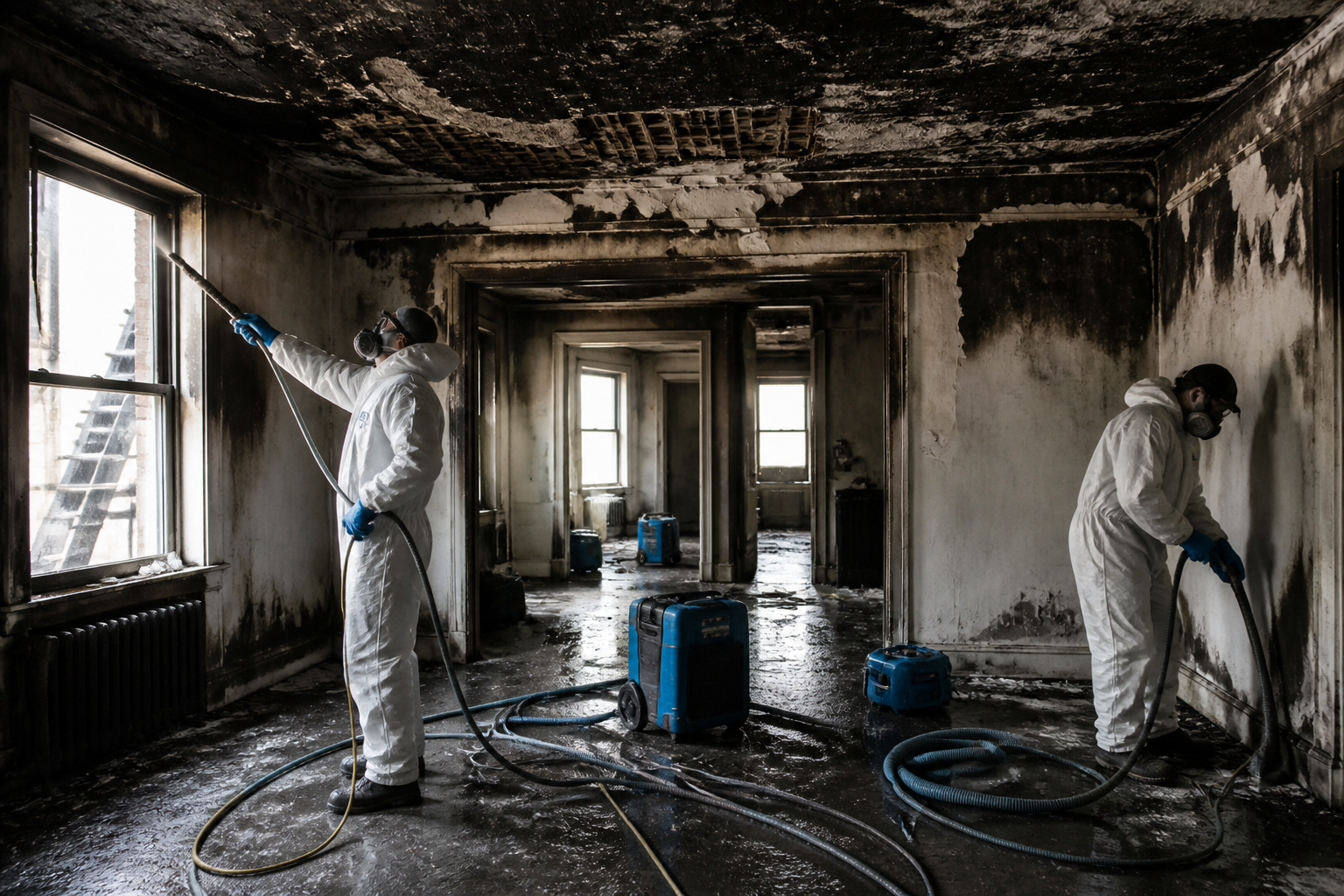
Crews walk every affected unit, common hallway, and mechanical room to map how far smoke traveled through the HVAC system. Windows get forced open where safe, negative air machines get set up, and damaged materials get bagged before they keep off-gassing. This is also when a water damage restoration company often gets pulled in too — sprinkler discharge and hose water from the fire department almost always complicate the smoke problem.
Week 1-2: Deep Cleaning, Ozone, and Hydroxyl Treatment
This stretch is where the real work happens. Thermal fogging, ozone generators (run only in vacant spaces), and hydroxyl machines cycle through the building while contents get wiped down, laundered, or replaced. Soft goods, carpet, and drywall either respond to treatment within days or need to come out entirely.
When Odor Removal Stretches Past 30 Days
Older Brooklyn brownstones with plaster walls and original ductwork hold smoke odor stubbornly, sometimes past the 30-day mark. Multi-tenant buildings elsewhere face similar delays — commercial fire damage restoration Texas jobs in older masonry buildings show the same pattern. Structural cavities and shared ventilation are usually the culprits.
What Actually Removes Smoke Smell (and What Just Masks It)
Ever wonder why the hallway of a Bed-Stuy walk-up still smells like a campfire three weeks after the flames are out? Because most fixes only cover the smell instead of pulling it out of the materials holding it. Odor removal after fire damage isn’t a spray-and-hope job in a 40-unit building — it’s a chemistry problem happening inside drywall, HVAC ducts, and carpet padding all at once.
Baking Soda, Vinegar, and Other Homeowner Fixes That Fall Short in Commercial Buildings
Baking soda, vinegar, and a bowl of white alcohol might knock down a smell in one apartment. Across a whole building? They don’t stand a chance. Bleach and hydrogen peroxide solutions can lighten a stain on a wall, but they don’t touch the smoke residue trapped in shared duct systems. If your building’s claim involves a fire damage restoration insurance claim, your adjuster expects documented, commercial-grade treatment — not a bucket of homemade neutralizer.
Why Ozone and Thermal Fogging Outperform Sprays and Air Fresheners
Ozone treatment and thermal fogging get into the same microscopic pores smoke particles did in the first place. That’s how odor actually gets neutralized instead of covered. Buildings we’ve worked outside New York — including a commercial water damage restoration Florida project — needed the same layered approach: ozone, sealant, and HVAC cleaning together, not one and done.
Factors That Slow Down Odor Removal in Brooklyn Apartment Buildings
Roughly 60% of the smoke particles from a structure fire are small enough to lodge inside porous materials — drywall, subflooring, HVAC insulation — where they sit and off-gas for weeks if nobody pulls them out. That’s the number that catches most building owners off guard. A single-family house might air out in days. A six-story walk-up in Bed-Stuy or Sunset Park? Different math entirely.
Here’s what actually stalls the timeline in multi-tenant buildings:
- Shared HVAC and duct systems that recirculate smoke particles between units long after the fire’s out
- Older brick-and-joist construction, common across Brooklyn’s pre-war stock, which traps smoke in wall cavities and floor gaps
- Occupied units nearby that limit access to shared walls, requiring phased work instead of a full teardown
- Humidity and slow air exchange in ground-floor and basement units, which lets soot residue linger and mold risk climb
Commercial buildings carry extra complexity residential jobs don’t. A proper commercial fire damage restoration plan has to account for elevator shafts, common corridors, and building-wide ventilation — not just the unit where the fire started. That’s a very different scope than clearing smoke smell out of a single apartment.
And it’s not only fire. Buildings that took on firefighting water damage face the same layered timeline problems seen in commercial water damage restoration Manhattan projects — moisture trapped behind walls slows drying, and slow drying means odor lingers longer.
Getting Your Building Back to Code and Keeping Tenants Informed During Remediation
Most property managers assume a clean-smelling hallway means the building has passed inspection. That’s not true. Fire marshals and NYC housing inspectors care about structural integrity, electrical safety, and air quality readings — not just whether the odor removal after a fire damage job left the lobby smelling fresh. A building can smell fine and still fail if smoke residue sits behind drywall or inside HVAC ductwork.
Getting a certificate of occupancy reinstated in Brooklyn typically requires documented air quality testing, not a subjective sniff test from a super or leasing agent.
Tenant communication matters just as much as the technical work. Best practice for multi-tenant buildings:
- Post daily updates in common areas — elevator, mailroom, front entrance
- Give tenants a realistic timeline, not a best-case guess
- Flag which floors have containment barriers and which are cleared for normal use
- Offer a direct contact line for smell complaints so nothing goes unreported
Buildings with mixed commercial and residential space need coordinated scheduling, since a delayed office floor can hold up recertification for the entire property. If your portfolio spans boroughs, the process runs the same whether it’s commercial water damage restoration Brooklyn crews are handling or a sister building needs commercial fire damage restoration Queens teams to manage. Consistency across properties keeps insurance documentation clean and tenants less anxious.
Frequently Asked Questions
How do you get rid of that burnt smell after a fire?
You can’t spray it away. Smoke particles work into drywall, insulation, HVAC ductwork, and porous ceiling tiles throughout a building, so real odor removal after fire damage means thermal fogging, ozone or hydroxyl treatment, and sealing porous surfaces that can’t be cleaned. In a multi-tenant building, we also check units adjacent to the fire floor — smoke migrates through shared shafts and returns more often than owners expect.
How long does it take for smoke smell to go away after a fire?
For a single unit with light smoke damage, 3 to 5 days of active treatment is typical. For a Brooklyn brownstone or a mid-rise with shared HVAC, plan on 1 to 3 weeks once you factor in duct cleaning, content pack-out, and re-testing air quality before tenants move back in. Untreated buildings can carry a burnt smell for months because nobody addressed the ductwork or attic space.
What absorbs fire smoke smell?
Baking soda — activated charcoal are decent passive absorbers for light residual smell in a small room, but they won’t touch heavy smoke saturation in a commercial building. Professional-grade odor removal after fire damage relies on thermal foggers, ozone generators, and hydroxyl machines that break down smoke molecules at a chemical level instead of just masking them. For soft goods and clothing, a vinegar soak followed by a proper detergent wash pulls a surprising amount of odor out of fabric.
How long does it take for a burnt smell to leave a building on its own, with no treatment?
Realistically? It doesn’t. Smoke residue is acidic and keeps off-gassing, especially in humid weather common to Brooklyn summers, so a burnt smell can linger for a year or longer without professional intervention. We’ve walked into buildings where a fire happened 18 months prior, and the smell was still detectable in carpet and HVAC filters.
Can I just clean everything myself with vinegar, baking soda, and bleach?
For a small residential kitchen fire, homemade solutions and elbow grease sometimes get you 70% of the way there. For a commercial or multi-family building, no — bleach and vinegar don’t reach smoke residue trapped inside wall cavities, ceiling plenums, or shared ductwork. We still use vinegar and baking soda as supplemental steps on fabric and dishes, but the building-wide fix requires equipment tenants and staff shouldn’t be operating themselves.
Do I need to replace carpet and drywall, or can they be cleaned?
Depends on how close the material was to the fire and how long smoke sat in it. Drywall and insulation near the fire origin usually need to come out — they’re too porous to fully deodorize. Carpet, tile, and hard flooring farther from the source can often be cleaned and treated instead of replaced, which saves the property owner real money on a large-loss claim.
Will my building’s insurance cover odor removal after fire damage?
That depends entirely on the policy, so we won’t tell you what your coverage guarantees. What we can tell you is that we work directly with the adjuster handling the claim, document the damage room by room, and provide the paperwork needed to support a fair settlement. That coordination is often the difference between a fast payout and a stalled one.
What makes odor removal in a multi-tenant commercial building harder than in a single-family home?
Shared HVAC systems, common hallways, and connected wall cavities. Smoke doesn’t respect unit boundaries — it travels through returns and risers, which means a fire on the third floor of a Brooklyn multi-family can leave odor complaints on the fifth. That’s why we always inspect and treat adjacent units, not just the unit where the fire started.
Do dishwashers and laundry machines need special cleaning after a fire?
Yes, if smoke reached the kitchen or laundry room. Run dishwashers empty with a vinegar cycle and check dish racks and lint traps in laundry machines — soot residue collects there and reintroduces smell into clean loads. It’s a small step that gets skipped constantly, and it’s why some units still smell faintly of smoke weeks after everything else looks clean.
A brownstone in Park Slope and a mid-rise near Downtown Brooklyn won’t smell clean on the same schedule — shared HVAC runs, dense wood framing, and old plaster all change the math. That’s the honest answer for any property manager asking for a single number. What matters more than the calendar is the sequence: contain the damage fast, bring in ozone or hydroxyl treatment instead of relying on sprays that just cover up the problem, and document every step for tenants and adjusters alike. Skip a stage, and odor removal after fire damage turns into a 60-day headache instead of a two-week fix.
Tenants don’t care about equipment specs. They care about move-back dates and whether the building feels safe again. Give them both, backed by a crew that actually understands pre-war construction and multi-unit airflow.
If a unit in your building is still holding onto smoke smell, don’t wait for complaints to pile up. Call Dual Restoration and get an assessment scheduled before the odor spreads to units that were never even near the fire.