What You’ll Need
- Your building’s insurance policy — declarations page and adjuster contact info, if you already have a claim open
- HPD violation paperwork — if you’re a Brooklyn landlord facing a mold deadline, have the notice in hand
- A short list of candidate contractors — 3 to 5 companies serving NY, NJ, CT, or PA
- State licensing lookup access — bookmark your state’s contractor license search before you start calling
- IICRC certification lookup — for cross-checking certificate numbers a company gives you
- Building details on hand — unit count, square footage, and whether it’s occupied during repairs (clinics, medical offices)
- A phone, after hours — you’ll need this to actually test a company’s 24/7 response claim
- Time: 1-2 hours — enough to call 3-5 companies, check licenses, and compare answers before you commit to one
A pipe bursts on the sixth floor of a Sunset Park co-op at 2 am — within an hour, there are three trucks parked outside claiming they can help. Only one of them is actually a licensed disaster recovery company. The other two? Guys with wet-vacs and a Google Business Profile.
Here’s the problem for Brooklyn property managers: anyone can slap a logo on a van and call themselves a restoration contractor. Licensing, IICRC certification, real insurance coordination — that stuff doesn’t show up on a flyer. It shows up when you ask the right questions before you sign anything, not after the drywall’s already ripped out.
Whether you’re managing a walk-up in Bushwick or a mixed-use building near Downtown Brooklyn, the vendor you pick determines whether your adjuster gets clean documentation or a mess of phone tag.
What You’ll Need Before You Start Vetting a Disaster Recovery Company
Picture this: a pipe bursts on the fourth floor of a Bed-Stuy walk-up at 6 am, water’s running down the stairwell, and your phone won’t stop buzzing with tenant complaints. That’s the moment most property managers start Googling — and the worst possible time to figure out what makes a disaster recovery company legitimate versus a guy with a wet-vac and a magnetic sign.
Before you make a single call, pull three things together: your building’s current insurance policy (declarations page included), any open HPD violations if this is a mold or leak situation, and a short list of two or three contractors to compare. Don’t skip this step.
If your portfolio spans state lines, note that credentials matter regionally — a contractor handling large loss restoration New Jersey jobs needs separate licensing from one working strictly in Brooklyn. Have that distinction ready before you start comparing bids.
Step 1: Confirm the Company’s License and Insurance Coverage for NY, NJ, CT, or PA
No license, no job. That’s the rule Brooklyn building owners should follow before signing anything. A real disaster recovery company carries active licensing and insurance in the states it services — not just a business card and a van with a logo.
Ask for Proof, Not a Promise
Get the paperwork first, ask questions later. A licensed vendor hands over documentation without hesitation — if a contractor stalls when you ask about licensing in New York specifically, that’s your answer right there. This matters just as much if you manage a building in Jersey City or need a commercial restoration company Connecticut owners can verify against the state registry.
Check IICRC Certification
IICRC certification is the baseline for water mitigation, fire and smoke work, and mold remediation. Cross-reference the certificate number on the IICRC site directly — don’t just take a logo on a website at face value. Facilities managing clinics should also confirm healthcare facility disaster recovery experience specifically, since patient-occupied buildings can’t just shut down for repairs.
Step 2: Verify Local Brooklyn Response Time and Equipment Capacity
How fast can a crew actually reach your building once water’s spreading through a stairwell? That’s the question that separates a real disaster recovery company from a subcontractor working out of a pickup truck. Response time only matters if the equipment shows up with the team.
Ask What’s on the Trailer
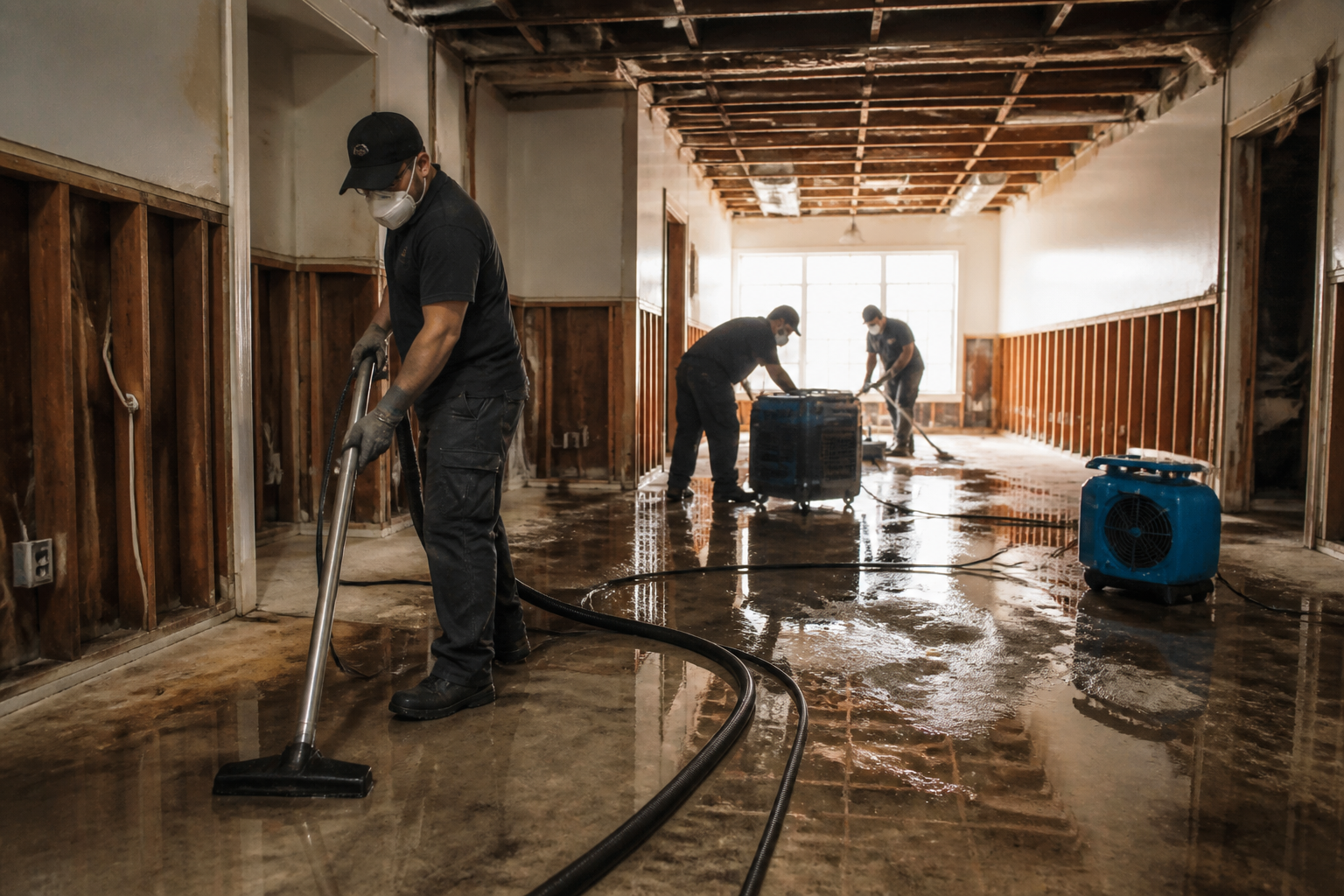
A company that rolls up with a shop-vac and no drying equipment isn’t built for a multi-family flood in Park Slope or Bed-Stuy. Before anyone arrives, ask what’s loaded on the trailer — extraction units, air movers, dehumidifiers, moisture meters. If they can’t answer specifically, that’s a red flag. Real capacity means enough gear to hit multiple floors of a Brooklyn walk-up at once, not one unit rotated room to room.
Test Their 24/7 Claim
Call after hours. A legitimate operation answers — it doesn’t route you to voicemail until 9 am. Dual Restoration’s 24/7 commercial disaster recovery services are built around that exact test: someone picks up, and equipment moves toward your building immediately.
Step 3: Confirm the Company Coordinates Directly With Your Insurance Adjuster
Roughly 30% of commercial property claims get delayed past 60 days for one reason: poor documentation handoffs between contractor and adjuster. That’s a Brooklyn building sitting half-repaired while paperwork bounces back and forth. Don’t let that be yours.
A serious disaster recovery company treats your adjuster as a direct point of contact, not a middleman you manage yourself. For multi-unit buildings across Bed-Stuy, Sunset Park, or Williamsburg, that documentation needs to match adjuster formatting from day one — photos, moisture logs, scope sheets, all of it.
Ask directly: will they call the adjuster themselves? Will they submit estimates in the format the carrier expects? For bigger jobs — a flooded basement across a 40-unit building, or fire damage spanning multiple floors — this matters even more. A large loss restoration company should already have this workflow built in, not improvised mid-claim.
If they hesitate on this question, that’s your answer.
Step 4: Match the Company’s Experience to Your Building Type
Here’s a myth worth busting: bigger isn’t always better, and a company that handles skyscraper jobs isn’t automatically the right fit for a small walk-up. The real question is whether their crew scales up or down to match your specific building.
Multi-Family and Mixed-Use Buildings
A six-unit walk-up in Bushwick and a 10-story mixed-use building in Downtown Brooklyn need different crew sizes and different project management. Ask for examples of comparable jobs — a company with real large-loss experience won’t dodge this. If you’re searching for a commercial restoration company near me, look for one that can show you a job at your building’s scale, not just a glossy list of services. Check their commercial restoration company near me page for the range of projects they’ve actually handled.
HPD Mold Violation Deadlines
If you’re a landlord staring down an HPD mold violation notice, ask specifically whether the company handles that paperwork and deadline pressure, not just the mold itself.
Healthcare and Occupied Facilities
If your property includes a clinic or medical office that can’t close during repairs, ask how the crew works around active occupancy. Not every restoration outfit has done this.
Step 5: Avoid These Common Mistakes When Choosing a Disaster Recovery Company
A Bushwick property manager once hired the first contractor who picked up the phone after a pipe burst flooded three units. No license check, no reference call — just a fast yes. Two weeks later, the drywall was still wet, and the insurance paperwork was a mess. Don’t repeat that.
Don’t hire based on who answers fastest. Don’t assume a national-sounding name means it’s licensed in NY, NJ, CT — PA — ask directly. Skip the reference check on a comparable Brooklyn building, and you’re gambling. And never sign anything that doesn’t spell out direct adjuster coordination in writing, whether the job involves mold, sewage, or fire damage restoration services.
Red Flags to Watch For
- No physical license number on file with the state
- Reluctance to name past commercial or multi-family jobs
- No mention of insurance coordination in their process
- Pressure to sign before an assessment is even done
How to Confirm You’ve Picked the Right Disaster Recovery Company
Trust, but verify. Once you’ve got your finalist, pick up the phone, ask for the license number again, and run it through NY, NJ, CT, or PA’s state licensing lookup yourself. Don’t take a website badge at face value.
Next, confirm they’re an IICRC certified commercial restoration contractor — not just certified for residential jobs, but specifically equipped for multi-family and mixed-use buildings across the boroughs. Ask how fast they can get a crew and equipment on-site, whether they’ll coordinate directly with your adjuster, and if they’ve handled buildings your size before — a four-story walk-up in Bed-Stuy is a different job than a 10-story building with a shared roof and multiple stacked units.
If a company checks every box — licensed, fast, adjuster-ready, experienced with Brooklyn’s building stock — you’ve got a real vendor. Not just a search result.
How-To FAQ
How long should vetting a disaster recovery company take?
Plan on a day, maybe two, if you’re moving fast. A phone call to confirm licensing, a check of the IICRC database, and one reference call is usually enough to make a call on a comparable Brooklyn multi-family job. Don’t drag it out past 48 hours — a real emergency doesn’t wait, and neither should your vetting.
What if the company can’t produce a license number on the spot?
Walk away, or at least press pause. A licensed disaster recovery company keeps that number handy — it’s not buried somewhere. If they need “a few days” to find it, that’s a red flag, not an oversight.
Is it safe to let a crew start work before insurance approves the claim?
Emergency mitigation — like extracting water or tarping a roof after a storm — usually can start before approval, since delay causes more damage. Full reconstruction should wait until your adjuster signs off, and a company that coordinates directly with adjusters will tell you exactly where that line sits.
What’s the difference between a disaster recovery company and a general contractor?
A general contractor rebuilds. A disaster recovery company handles the whole sequence — mitigation, drying, mold control, and insurance documentation — before reconstruction even starts. For a flooded basement in a Crown Heights building, you want the recovery company first, not a contractor with a hammer and no drying equipment.
Does it matter if the company is based outside Brooklyn?
Not necessarily, as long as they’re licensed in New York and can prove a real response time to your address — not just a promise. Ask directly: how many crews do they have that can reach Brooklyn within an hour, and what’s on the trailer when they show up?
What should I do if two companies both check every box?
Ask each one for a comparable large-loss reference — ideally a multi-family or mixed-use building close to your building’s size. The one that answers without hesitation and explains their adjuster process in plain terms is usually the safer pick.
A burst pipe in a Crown Heights rental or a mold notice on a Bushwick walk-up won’t wait for a vendor to figure out its own paperwork. That’s the real test. Licensing checks out or it doesn’t. Adjuster coordination happens on day one, or it never happens at all. And crew size either matches a 10-story mixed-use building or it doesn’t — there’s no middle ground on that one.
Property managers across Brooklyn who skip these checks usually find out the hard way, mid-claim, when a contractor can’t produce a license number or won’t return an adjuster’s call. Don’t be the manager explaining that to ownership. A disaster recovery company that’s actually built for this work will hand over its credentials before you even finish asking.
Dual Restoration is licensed and insured across NY, NJ, CT, and PA, works directly with adjusters from the first call, and has handled buildings from six-unit walk-ups to 10-story properties. Call before the next emergency hits — not during it.